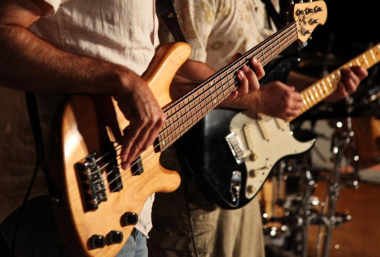
If you have wandered through a city on a Saturday night, you have probably found yourself in a bar listening to a cover band. You hear the first chords of a familiar song, and you find yourself singing along before you even buy a drink. The set jumps from disco to rock to pop without warning, featuring the biggest hits guaranteed to fill up the dance floor. The performers could be your co-workers on Friday, then rock stars on Saturday.
Behind that carefree vibe is a well-oiled system. Bars and nightclubs pay licence fees to music rights agencies like APRA/AMCOS or OneMusic in Australia and New Zealand. Bands fill out Performance Reports listing every track they played.
The music rights agency then uses those lists to send royalties to the original songwriters and publishers.
It is how the people who wrote your favourite songs still get paid when someone else performs them.
Tribute acts vs cover bands
For most cover bands, the legal side is a simple three-chord song: play the music, report the songs, keep the royalties flowing. But when a cover band becomes a tribute act, the arrangement becomes a little more complex. It is not just about the sound anymore. It is about the name, the look, and the brand that fans recognise instantly. When it comes to tribute acts, the name of the act or the logo on the poster can matter as much as the setlist.
Tribute acts aim to make you believe you are watching the real thing – or as close to the real thing as possible. They copy the sound, the moves, even the banter between songs. At the casual end, it is a heartfelt nod to a musical hero. At the polished end, it can be a full-scale production with costumes, staging, and note-perfect performances. What starts as celebrating a legacy can drift into unfairly taking advantage of or damaging someone else’s livelihood if the right precautions aren’t taken.
Rock brand – Tribute acts and IP infringement
The tricky part for tribute acts hits a different note when trade mark rights come into play. These protect the brand of the original artist. While copyright covers the “creative expression” such as the music, lyrics, performance and artwork, trade marks protect the name, logo, font, and imagery that keep an artist’s identity in tune.
A registered trade mark is the strongest way to protect a brand, allowing a straightforward pathway for artists to enforce their rights, while also acting as a deterrent through display on the trade mark register. However, even without a registered trade mark, artists do have other enforcement options if a tribute act cuts it too close.
These can include:
- Passing off – This is when a tribute act performs in a way that could make the public think they are the real band or officially endorsed. In other words, they are riffing on the original artist’s reputation for their own gain.
- Fair Trading Act – In New Zealand, you cannot make false or misleading claims about a performance. If a tribute act strikes a chord that makes audiences believe they are linked to the original artist, they could be off-key with the law.
- Australian Consumer Law – Australia’s equivalent works the same way. Misleading audiences about being associated with the original act is the fastest way to hit a sour note.
- Copyright Infringement – It’s not only the music that can potentially infringe. Photos, representations, artwork, and even costumes are considered artistic expressions, and can land you in a mosh pit if you use them in your advertising or performance.
For tribute acts, the best way to stay in harmony is simple. Respect the music, but don’t steal the spotlight on the brand. Or, seek the permission of the rights holder. There are a few examples of licensed tribute bands who operate under the license of the rights holder – such as Elvis Evolution or Queen Extravaganza.
And remember your audience: are you going to disappoint (mislead) others by using trade marks, or other words like “official” or “authorised”, when you’re not?
Some top (legal) hits
- Mamma Mia! – a 2021 lawsuit filed by Polar Music International, the record label responsible for ABBA, claimed that tribute act ABBA MANIA infringed on their intellectual property rights, including trade mark infringement, and passing off on the goodwill and reputation of the Swedish megastars.
The lawsuit was eventually settled, with the tribute act now including the disclaimer “Abba Mania is [in] no way associated, affiliated, or endorsed by Polar Music or ABBA.”
- A Marker in the Sand – A UK based Pearl Jam tribute act landed on a name that was a bit too on the nose, with the Seattle rockers taking issue with the London outfit “PEARL JAMM”. The original acts claim alleges confusion between PEARL JAM and PEARL JAMM, with damage to the original PEARL JAM brand, a claim that was denied by the tribute act as they were unaware of any actual confusion.
An important tip to remember, is that actual confusion is not a requirement for trade mark infringement or passing off – only that confusion or deception is likely.
In response to the legal threats, the tribute act did end up changing their name to LEGAL JAM.
- That’s the Way of the (legal) World – A 2024 lawsuit saw Earth, Wind & Fire LLC taking on the alleged deceptive use of the EARTH, WIND & FIRE LEGACY REUNION.
While marketed as a reunion, the members of the tribute act were side musicians and did not feature any of the original prominent members of the original band.
To make matters worse, the tribute act used official logos, names and even photos of the original members in their marketing, leading consumers to believe they were purchasing tickets to a reunion of the original, bona-fide Earth, Wind & Fire.
Ultimately, the Miami court did rule in favour of the original act, noting that even though the tribute act’s musician were technically members (albeit side members) of the original Earth, Wind and Fire, the marketing and advertising was still misleading and deceptive as to whether the main members of the band would be performing.
- Not Quite as Easy as a Sunday Morning – In a feud a little more close to home, the original members of the iconic 70’s funk group The Commodores have come to (legal) blows over sold out reunion shows in New Zealand.
Original Commodores frontman William King has scheduled a reunion tour with new members, causing a headache with the local promoter and local venues. The crux of the issue, is that the rights to the Commodores’ name in New Zealand is owned by another founding member, guitarist Thomas McClary, who even owns a registered trade mark for THE COMMODORES in classes 9 and 41.
New Zealand is only the latest battleground for the Commodores, with both members contesting ownership of the Commodores brand in the US. There, the US position upheld in the Court of Appeal, was that in light of an earlier agreement between Commodores’ band members, anyone who left the band also relinquished their common law rights in the Commodores brand. Seeing as McClary didn’t own the trade mark in the US (the original band did), and he left the band therefore giving up is rights, it was ruled that McClary could not use the Commodores brand to promote his own events in the US, with the injunction initially also capturing international use.
However, in 2023, the US Supreme Court held that US trade mark law did not have extraterritorial effect, raising questions whether the decision could actually prevent McClary from enforcing his rights in other countries. Seeing as McClary does own the trade mark in New Zealand, it has become the new jurisdiction for McClary to defend his rights.
On-key takeaways
If you do want to start a tribute band, be sure to take care in how you market your performance.
- Stay away from using logos, names, images and other distinctive identifiers of the original acts.
- Don’t market yourself in a way that may mislead consumers into believing you are linked to, or endorsed by, the original act.
If in doubt, contact one of our team to help make sure you stay on beat.
If you are an original artist and you think a tribute act is infringing on your rights, feel free to get in touch with one of our IP professionals.