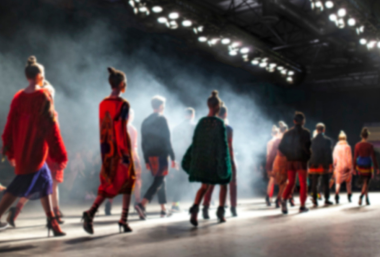
February and September are two of the most fashionable months of the year. This is when the big four of fashion weeks (London, New York, Paris, and Milan) host shows.
Other fashion shows worth paying attention to are New Zealand Fashion Week – set to take place in August this year – and Copenhagen Fashion Week – which showcases exciting brands and may be the only fashion show with a minimum set of sustainability standards for its entrants and partners[1].
Fashion show history
Fashion shows began as presentations of beautiful clothes on mannequins. Today, fashion shows are live spectacles that can be viewed anywhere from the front row to your desk via social media[2]; Lady Duff Gordon is considered to have staged the first ‘catwalk show’ with scenery, lighting, and music[3]. She was a couturière to European and American women and a Titanic survivor[4].
Once held in studios and department stores, fashion shows are now held in grand venues. The first episode of Netflix show, Halston, shows the American designer showcasing a collection in New York’s Bloomingdales. The Grand Palais was, under the tenure of Karl Lagerfeld, the venue of choice for almost every Chanel show from around 2006 with elaborate set designs[5].
As a result of this evolution, the best fashion shows are not just about the clothes on display but the entire mise-en-scene. This is comprised of elements such as the music, the script, the choreography, and the lighting. These additional elements are further avenues for brands to showcase their identity by building their world and telling the story of who they are.
Fashion shows drive sales and cement a brand’s identity. As such, they are one of the many tools available to fashion brands to drive growth. While designers and creative departments are important for a great fashion show, legal protection can also play an important role in a distinctive and successful fashion show.
Copyright
Copyright attaches automatically upon creation of an original applicable work. This may include literary, dramatic, musical, artistic works, film or sound recordings[6].
In relation to a fashion show, there are many layers of copyright: from the garment designs themselves, to the branding and logos used, sketches of runway collections, photographs of the garments, photographs or other recordings of the event, other audio-visual elements of the event such as music and choreography, and all the related promotional and advertising content. Copyright may apply to the performance of the show itself, comprising the choreography of the models, in combination with music and lighting arrangements, and overall presentation. This performance may not only be viewed live, but also recorded or broadcast live.
Copyright gives the owner the exclusive right to exploit the relevant work. For example, a fashion brand that owns copyright in its sketches, photographs and video imagery from its collections can license those to museums and/or create coffee table books[7]. The fashion brand or show organiser may own the rights to a recording of the performance, and so on. Copyright also allows the relevant owner to stop others from making unauthorised copies.
However, it is also important to balance the rights of the designers, fashion brands, show organisers, and other service providers. For example, contractor agreements may include the right for photographers to be named in relation to photographs they have produced, even if those are commissioned works in which copyright is ultimately owned by the fashion brand. Similarly, make-up artists may be named for works they create. The rights of other designers, artists, or musicians who are engaged to showcase their works as part of a fashion show will also need to be considered. The distinction between copyright ownership and authorship, and the various types of ‘use’ that could be made of a copyright work, are examples of issues that should be addressed in any employment and/or contractor agreements entered into.
Does your fashion brand own its copyright?
Design
Registered designs protect new and original visual features of a product that may influence choice or selection by the potential customer. Designs however do not protect purely functional features. Once registered, design protection can last up to 15 years.
While it may not be feasible to register every design feature from every collection, any features that have the potential to be house codes should be considered. Examples of these can include unique prints, appliques, and shapes of certain features.
Importantly, from a fashion perspective there are major differences in design law in Europe (including the UK) and in New Zealand and Australia. For example, in Europe, unregistered designs can be protected; and designs may still be registered up to 12 months after publication. In New Zealand, one would have to rely on copyright only if the design was unregistered; and, as a general rule, there are no grace periods for designs that have been prior published. This means that designs should not be publicly disclosed in New Zealand (including online) before a design application is filed. Australia is different again: their law on copyright-design overlap may result in the loss of copyright as well as design, if not registered.
As such, it is important that any design protection is considered before a fashion show or other publication of the relevant design.
One of the benefits of registering a design is that it provides details regarding the date of the design and the owner. If a designer needed to enforce their rights, these are both elements that would need to be established in a copyright case but exist by virtue of registering a design.
In New Zealand, a design application can have a relatively fast turn around between application and registration. IPONZ reviews design applications within 15 working days of receipt. IPONZ reviews the applications, if there no objections are raised, the application will procced to registration. However if any objections are raised, applicants then have 12 months to address these.
Trade marks
Trade marks are important for any brand, and fashion week is no exception.
Fashion brands own registered and unregistered trade mark rights. This may be in the brand’s name, logos, slogans or maybe even in the name of a collection. New Zealand Fashion Week is a registered trade mark owned by New Zealand Fashion Week Limited[8].
Fashion shows can be a great time to unveil new iterations of a brand’s logo – for example Marni changes how their logo looks every drop[9]. Crucially, Marni has the name registered as a word trade mark. This allows it to protect the name in almost every stylisation.
If considering debuting a brand refresh during fashion week, whether by changing the logo (e.g., the 2018 removal of the horse from the Burberry logo) or changing the stylisation of the wording as per the Marni example above, it is important to have a trade mark strategy that affords the best protection.
Trade marks are a badge of origin and can help build recognition. Fashion houses like Gucci, Bottega Veneta, Burberry and Valentino have all recently used colour as a way to signify the brand[10]. Even if not strictly enforceable, these can help establish or cement brand identity[11].
A brand narrative is important for building brand recognition. As such, it is important that a brand not only knows how its trade marks are used, but to also exercise some control over the use. For example a brand should know if its trade marks are used to promote fashion week or any surrounding events.
Does your trade mark strategy protect you and allow you control over your trade marks?
Contracts, license, and other agreements
Fashion shows are not individual endeavours and collaborations in fashion are not new. These collaborations may be in the collections themselves (e.g., the iconic Louis Vuitton x Takashi Murakami[12]) or in the fashion shows (e.g., musical performances at the Victoria Secret fashion shows). Even if a show does not include live musical performances, it is likely that it will involve music. Staging a fashion show may also require models, stylists, make-up artists, designers and choreographers. The more elaborate the show, the more people are involved.
Fashion brands may need to consider licensing agreements with the relevant copyright holders to have music at the show or contractor agreements with make-up artists and models. These agreements need to make it clear what services are being provided and when, the scope of use of the intellectual property (IP) rights, and if applicable, the confidentiality requirements. Parties must also be clear about their relationship, responsibilities, and entitlements; for example, a stylist may be an employee of or a contractor to the company. Getting it wrong may have serious consequences.
More and more brands are engaging in influencer marketing and appointing brand ambassadors. Influencer and ambassador contracts should stipulate how the parties may use each other’s respective IP, and the scope of use for any deliverables under the agreement. It is also important for the parties to be aware of their responsibilities under the advertising agency standards and codes. This is particularly relevant where live shows or broadcasts are concerned.
Where a fashion show is broadcasted, it is important to consider who is doing the broadcasting. For example, a brand broadcasting its own show via its own social media will own the copyright in that content. Similarly, a person sitting front-row, for example a brand ambassador, streaming the show to their viewers, will own that content. As such, a brand may want to consider owning the IP in the content created by its ambassadors at its show.
It is therefore important that contracts are in place that adequately deal with use and protection of important brand assets.
Conclusion
The role for a lawyer in a fashion show begins many months in advance, preferably during the planning and preparation stage. IP should be one of the first and most important legal considerations for a creative endeavour like a fashion show.
If you are showing at Fashion Week, it’s not too late to loop in a lawyer or legal team.
[1] https://copenhagenfashionweek.com/sustainability-requirements
[2] I may or may not have watched shows during lunch breaks on Instagram or later on YouTube.
[5] My favourites include the 2014/15 fall winter collection where the Grand Palais was turned into a supermarket (iconic!) and the fall 2017 couture show which recreated the Eiffel Tower.
[6] Section 14(1)(a) – (b) Copyright Act, 1994
[7] I own a coffee table book purchased after visiting a museum exhibition of the work by Dutch designer, Iris Van Harpen and at the time of writing I had recently been to a Vivienne Westwood exhibition which included images and videos from the late designer’s collections.
[8] NYFW, New York Fashion Week, LFW and London Fashion Week are also registered trade marks in their respective countries, owned by the entities responsible for the fashion weeks.
[10] There is Rosso Ancora aka Gucci red, Burberry blue, Bottega green and Valentino pink in reference to the fall 22/23 collection in which every item was hot pink.
[11] In this current climate of Creative Director musical chairs, this is not necessarily a bad thing.
[12] The first Louis Vuitton x Takashi Murakami collaboration debuted in 2003. In celebration of the era-defining collaboration, the fashion brand has launched several re-editions, with the latest collection expected to drop in March.