
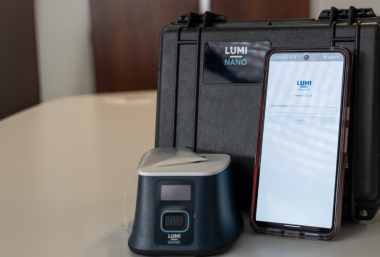
The result of a unique collaboration between forensic scientists and New Zealand police, LUMI Drug Scan is a handheld drug scanner that’s changing the way police detect drugs in the field.
Like all great inventions, the team behind LUMI Drug Scan set out to solve a real-world problem. Prior to 2022, frontline officers had to use a chemical colour test when they came across a suspected illicit drug sample. That test could be unreliable, and it also exposed officers to risk – so police were looking for a better alternative.
The LUMI device can accurately detect the presence of a wide range of illicit drugs – including cocaine, MDMA (aka ecstasy) and methamphetamine – within seconds.
“That was the problem statement we started with,” says Dion Sheppard, of the New Zealand Institute for Public Health and Forensic Science (formerly ESR), who has led the project from the beginning.
“If a police officer was attending a search warrant or processing someone at the station or identifying a substance in a vehicle – they needed technology that would help them make instant and accurate decisions about how to proceed.”
Armed with this brief, a group of forensic and data scientists, software engineers and police officers got around a table.
Says Dion: “It was a really fascinating journey to be on, because it brought together the end-user problem, the front-line experience, and the diverse expertise we have at PHF Science to co-design the solution.”
Reducing drug harm
Now, when an officer intercepts a suspected sample, the LUMI device can accurately detect the presence of a wide range of illicit drugs – including cocaine, MDMA (aka ecstasy) and methamphetamine – within seconds.
The suite of New Zealand-grown technology has three aspects: a hand-held device, the LUMI Analysis app on the officers’ smartphone, and an AI engine that analyses the results.
As a forensics organisation, PHF Science has unrivalled access to a range of illicit drug samples coming through their laboratory from Police, Customs and MedSafe. This gives it a unique advantage over private companies developing similar technology.
“Street intercepted samples can have a really broad range of concentrations and purity levels, mixtures and cutting agents etc,” explains Dion.
“And using machine learning, we can train the model to recognise these. So that when an officer seizes a street sample which can be cut with who-knows-what, there’s a really good chance the model’s seen something like it before and is able to classify it.”
The LUMI Drug Scan service also incorporates the LUMI Dashboard. This is an analytics interface that helps Police track the presence of drugs in the community – including when and where different types of drugs are being used – to help them allocate resources nationally.
“For instance, we can see increases around summer festival periods where drugs like MDMA are more common...so those data sets are really valuable in helping police make decisions about how to respond and reduce drug harm in their communities.”
An award-winning solution
First rolled out in mid-2022, LUMI Drug Scan recently celebrated its third-year anniversary. To date, 150 devices have been deployed across Aotearoa’s 12 police districts, around 2,500 Police staff have been trained to use it, and more than 15,000 samples have been analysed.
This home-grown solution has won global acclaim, including the Excellence in Forensic Science award at the 2023 World Police Summit.
The LUMI team also has partnerships with various international drug enforcement agencies across the UK, US, Australia and the Pacific.
“The international collaboration with different agencies also provides a real win-win, in that each organisation can tip in their local knowledge and experience to benefit everyone else,” says Dion.
The IP strategy
Given its unique capabilities and global potential, PHF Science’s intellectual property has been carefully protected from day one – using a mix of trade secret protection and registered trade mark protection of the name and logo.
Much of the IP surrounding the technical aspects of the product is protected by trade secret.
“We chose that approach over patenting because with a patent, we’d have to disclose specifically what we were doing,” says Dion.
The other component of protection sits with the brand name. The goal is to prevent the brand name entering the common lexicon, which can sometimes happen to groundbreaking products where no generic name exists (like ‘hoover’ or ‘rollerblade’).
“We wanted a name that people would gravitate towards because it was trusted...to carve out a space where people could recognise LUMI Drug Scan as being the reliable choice for law enforcement.”
It was even mentioned in a fictitious scenario on the TVNZ series, The Gone.
“The actor had found some drugs and they talked about needing to get the LUMI device to analyse it,” says Dion.
“It was great to see it move beyond law enforcement and forensic science circles and into a daily conversation on a TV show....”
Global protection
The LUMI team works mostly with AJ Park Principal Kate Giddens, supported by solicitor JD Ward, and litigator Fionna Cumming.
As well as strategic advice in protecting the novel invention, Dion says AJ Park’s worldwide network has also proved invaluable.
“There was one instance in particular where we were filing a response to someone else’s claim to use LUMI, and we really needed some local advice around how to respond in appropriate wording that would be relevant for that local IP office,” he says.
“AJ Park is able to cover all the specifics and intricacies of trade mark filing, as well as having the knowledge of different jurisdictions and connections through to other countries.”
Written by Libby Schultz